THIS SITE IS SECURED BY THE "HOLY" TRINITY: FATHER, WORD, AND HOLY SPIRIT (I SAINT JOHN 5:7),
AND PROTECTED BY THE FIRST AMENDMENT TO THE NEW JERUSALEM CONSTITUTION!!
ENTER PAGE 2 TO ACCESS HUNDREDS OF MORE TIMELY, TRUTHFUL, AND NUMERICAL ARTICLES!
"THE SCEPTRE SHALL NOT DEPART FROM JUDAH, NOR A LAWGIVER FROM HIS LOINS, UNTIL
SHILOH COMES, AND THE PEOPLE SHALL BE GATHERED UNTO HIM" (GENESIS 49:10).
SHILOH CAME 2000 YEARS AGO.....HE PREDICTED THAT THE REBELLIOUS JEWS
WOULD "FALL BY THE EDGE OF THE SWORD. AND BE LED AWAY CAPTIVE
INTO ALL NATIONS. AAND JERUSALEM WOULD BE TRODDEN DOWN BY
THE NATIONS UNTIL THE TIMES of the NATIONS SHOULD BE FULFILLED"
(SAINT LUKE 21:24, GREEK ORTHODOX VERSION).
IF THE PEOPLE OCCUPYING OLD JERUSALEM TODAY ARE REAL "JEWS," THAT MEANS
THAT JEWISH MESSIAH JOSHUA BEN DAVID IS A FALSE PROPHET . . . OR A LIAR!!
"FOR UNTO US A CHILD IS BORN, UNTO US A SON IS GIVEN, AND THE GOVERNMENT SHALL
BE UPON HIS SHOULDERS; AND HIS NAME SHALL BE CALLED WONDERFUL, COUNSELLOR,
EL SHADDAI, THE EVERLASTING SON, THE PRINCE OF PEACE" (PROPHET ISAIAH 9:6).
JEHOVAH RECOGNIZES ONY 1 ISRAEL THAT WAS FOUNDED ON THE DAY OF
PENTECOST ((HEBREW SHAVuOUT) hWHEN THE HOLY SPIRIT
DESCENDED ON 120 MEN AND WOMEN GATHERED (N THE
UPPER ROOM IN OLD JERUSALEM (ACTS CHAPTER 2).
SAINT PETER AND SAINT MIRIAM—THE VIRGIN MOTHER
OF THE MESSIAH—WERE PRESENT AT THE
BIRTH OF SPIRITUAL ISRAEL.
PEOPLE WHO RECOGNIZE ANY OTHER ISRAEL ARE GUILTHY OF
LYING TO THE HOLY SPIRIT LIKE ANANIAS AND SAPPHIRA WHO
DROPPED DEAD AT THE FEET OF SAINT PETER (ACTS 5:1-11).
"AS FOR MY LAST DAYS PEOPLE, CHILDREN ARE THEIR OPPRESSORS,
AND WOMEN RULE OVER THEM"(PROPHET ISAIAH 3:12).
ANTICHRIST DENIES THE FATHER AND THE SON
ANTICHRIST CHANGED THE HEBREW-CHRISTIAN-CHRONOLOGY!!
JANUARY IS BATTLE OF NEW ORLEANS MEMORIAL MONTH!!
IN MARCH 2014, THE REAL VLADIMIR PUTIN WS REPLACED BY A DOUBLE!!
APRIL 13 IS FULL MOON PASSOVER-RESURRECTION ON DAY!!
JUNE IS REMEMBER THE MIRACULOUS UNSINKABLE USS LIBERTY MONTH!!
JULY IS CELEBRATE THE BIRTH OF THE NEW JERUSALEM MONTH!!
SEPTEMBER IS ROMA LIBERATION MONTH!!
OCTOBER IS REFORMATION MONTH!!
REMEMBER, REMEMBER, NEW BOSTON AND THE KENNEDY ASSASSINATION!!
DEMAGOGUE THEODORE ROOSEVELT FAKED HIS ASSASSINATION ATTEMPT!!
WHITEWASHED: ST. PATRICK WOULDN'T APPROVE OF ST. MARY MAGDALENE LAUNDRIES!!
MILITIA OF JESUS SPY IN DUBLIN AND ROMA
THE ANGLO-AMERICAN GESTAPO WAS CHARTERED IN 1947
 |
JEHOVAH COMPARES ALL THE FIRSTBORN TO DONKEYS OR ASSES!! (TANAKH EXODUS 13:13, 34:20, JOB 11:12). THAT IS WHY THE JEWISH MESSIAH SAID: "YE MUST BE BORN AGAIN" (SAINT JOHN 3:3, I SAINT PETER 1:23, 2:2 DOUAY-RHEIMS VERSION). |
 |
|---|
JOSHUA BEN DAVID—THE WORD MADE FLESH—WAS BORN OF THE VIRGIN MIRIAM IN BETHLEHEM IN
ORDER TO BYPASS DONKEY DNA (ISAIAH 7:14, MICAH 5:2, SAINT MATTHIAS 1:23, SAINT JOHN 1:14).
YOU ONLY LIVE ONCE! . . . "BORN AGAIN" IS NOT THIRD REICH REINCARNATION OR RECYCLING!!
(SAINT PAUL'S EPISTLE TO THE HEBREWS 9:27).
IN 1781 BC, JACOB (SUPPLANTER) WAS BORN AGAIN AT THE BROOK JABBOK AND
HIS NAME WAS CHANGED TO ISRAEL (PRINCE OF EL). (GENESIS 32:23-32).
MOSES THE LAWGIVER MARRIED AN ETHIOPIAN WOMAN!
ETHIOPIA IS THE
BIBLICAL NAME FOR AFRICA (NUMBERS 12:1-15, ACTS 8:26-39).
PALESTINE IS NAMED AFTER THE PHILISTINES WHO WORSHIPPED DAGON (BIG FISH IN HEBREW).
FALSE PROPHET MUHAMMAD IS PROPHETICALLY SYMBOLIZED AS "THE ASSYRIAN" IN ISAIAH CHAPTER 36.
HIGHWAYMAN ROBERT MOSES FINANCED THE TWIN TOWERS!!
"HE WHO WOULD THE WORLD WIN (FOR JESUITISM ) MUST IN SOUTH AMERICA BEGIN!"
THE MANY FACES OF WINSTON CHURCHILL UNMASKED AT LAST!!
THE WINSTON CHURCHILL DOUBLES PICTURE GALLERY!!
THE AUTHENTIC PORTRAIT OF OMEGA MAN "SAINT" GEORGE WASHINGTON
OMEGA MAN "SAINT" GEORGE WASHINGTON UNMASKED AT LAST!!
THE CATHOLICS CONSIDERED CHARLES III (1766–1788) TO BE THEIR ONLY LAWFUL KING!!
JULY IS MOON LANDING LUNACY MONTH!!
A TOP SECRET GAY GLOBAL NUN WAS CANONIZED IN JULY 1947
AUGUST IS ANNUNCIATION AND WORLD WAR I MEMORIAL MONTH!!
NOVEMBER IS JACKIE KILLED JACK ANNIVERSARY MONTH!!
THE ABOMINATION OF DESOLATION HAS BEEN REVEALED AT LAST!!
THE CORRUPT FLAVIUS JOSEPHUS CHRONOLOGHY!!
"HOLY COW" THE REAL RISHI SUNAK WAS REPLACED WITH A DOUBLE!!
THE ADOLF HITLER DOPPELGÄNGERS REVEALED AT LAST!!
BRITANNIA ALMOST GROUNDED THE BOEING COMPANY!!
HERE ARE 166 PROFILES OF THE 16 MOST POPULAR NAMES IN THE PAPAL DYNASTY!!
PENNSYLANIA SENATOR JOHN HEINZ WAS ASSASSINATED!!
THE ROYAL MURDERS IN BABYLON ON THE THAMES REVEALED AT LAST!!
THE TOP SECRET ROYALS TWINS LILIBET AND ELIZABETH!!
GEORGE WASHINGTON WAS THE GREAT-GRANDSON OF KING CHARLES II
NATO—NORTH ATLANTIC TERRORIST ORGANIZATION HQ IS LOCATED IN BRITISH BELGIUM!!
FRIAR BENJAMIN FRANKLIN UNMASKED AT LAST!!
PRESIDENT JAMES MADISON UNMASKED AT LAST!!
CORRUPT POLITICIANS HENRY CLAY AND HILLARY CLINTON!!
THE MIRACULOUS PRESIDENTIAL DEFEAT OF "CORRUPT BARGAIN" HILLARY CLINTON IN 2016
7 PRESIDENTS SERVED BEFORE GEORGE WASHINGTON
NO STATE LEGISLATURES RATIFIED WASHINGTON'S TOP SECRET "CONSTITUTION"
THE 1776 PENNSYLVANIA CHRISTIAN CONSTITUTION!!
DEMAGOGUE THEODORE ROOSEVELT AND THE PANAMA CANAL CONSPIRACY!!
PRESIDENT WOODROW WILSON UNMASKED AT LAST!!
THE SAWDUST CAESAR BENITO MUSSOLINI DOUBLE!!
DECEMBER 2022 IS IMMACULATE CONCEPTION DECEPTION MONTH!!
NOVEMBER 2022 IS WORLD WAR I ARMISTICE MONTH!!
LAW PROFESSOR JOE BIDEN REPLACED SENATOR JOE BIDEN IN MAY 1988
THE MILITIA OF JESUS MARYLAND PLANTATION!!
SIR ISAAC NEWTON UNMASKED AT LAST!!
| THE CONGO COVER-UP TRILOGY "LET MY PEOPLE GO, PHARAOH" (EXODUS 5:1). |
|---|
| THE BRITISH BELGIAN CONGO PHARAONIC STATE!! |
| THE BRITISH BELGIAN CONGO SUPPLIED URANIUM TO NAZI GERMANY!! |
| PATRICE LUMUMBA AND DAG HAMMARSKJOLD ASSASSINATIONS!! |
MYSTERY BABYLON DEMOLISHED THE TWIN TOWERS ON 9/11
THE PORT AUTHORITY OF LONDON, NEW YORK, AND NEW JERSEY!!!
ANTICHRIST CHANGED THE CHRISTIAN CALENDAR!!
AUGUST IS SAINT BARTHOLOMEW'S DAY MASSACRE MEMORIAL MONTH!!
BILLY GRAHAM WAS THE LAST DAYS PIED PIPER!!
THE WARMONGERS WHO STARTED WORLD WAR I UNMASKED AT LAST!!
THE VICKERS-MAXIM-KRUPP MACHINE GUNS KILLED MILLIONS OF SOLDIERS!!
BELLOW WOOD WAS THE NEW JERUSALEM THERMOPYLAE
PATRIOTIC WALT DISNEY WAS AN AMBULANCE DRIVER IN WORLD WAR I
THE 13 STRIPES STAR-SPANGLED BANNER!!
EXPOSING THE "DEEP THINGS" OF LEVIATHAN IN THE LAST DAYS!!
(JOB 41:11, PSALM 74:14, ISAIAH 27:1 Apocalypse 2:24).
BRITANNIA MISRULED THE WAVES—THE CAPTAIN OF THE OLYMPIC WAS A DOUBLE!!
THE SHORT LIFE AND TIMES Of SUBMARINE INVENTOR JULIUS HERMANN KROEHL
THIS SITE IS CHANGING RHODES "SCHOLARS" INTO JACKASSES!!
(NUMBERS 22:28, II SAINT PETER 2:16, APOCALYPSE 2:14).
UNION JACK THE RIPPER UNMASKED AT LAST!!
FROM RUSSIA WITH INCEST—THE REAL REASON FOR THE DOWNFALL OF THE ROMANOVS
KISSIN' COUSINS ARE BANNED IN THE NEW JERUSALEM
"CHURCH MILITANT" WINSTON CHURCHILL TITANICED OVER 400 BRITISH ITALIANS!!
"CHURCH MILITANT" WINSTON CHURCHILL TITANICED 645 AUSTRALIANS!
"CHURCH MILITANT" WINSTON CHURCHILL FOUNDED THE EDOMITE STATE OF "ISRAEL"
THE CHURCH OF ROMA UNMASKED AT LAST!!
THE PLAIN TRUTH ABOUT PURGATORY—IT DOESN'T EXIST!!
HILLARY CLINTON SENT BEAU BIDEN TO "PURGATORY" IN MAY 2015
I CANNOT TELL A LIE: I DID CHOP DOWN THE BABYLONIAN TREE!!
TUDOR DOUBLE TROUBLE—KING HENRY VIII AND HIS 8 BASTARD CHILDREN!!
THE QUEEN ELIZABETH DOUBLE WAS SHAKE-SPEARE!!
SIR ISAAC NEWTON UNMASKED AT LAST!!
GONE WITH THE WINDSORS: THE DUCHESS OF WINDSOR WAS A TRANSGENDER!!
O JEHOVAH, our JEHOVAH, how majestic is your name in all the earth (Psalm 8:9).
"I AM ALPHA AND OMEGA, THE FIRST AND THE LAST" (ISAIAH 44:6, APOCALYPSE 1:11, 22:13).
FOR THERE ARE THREE WHO BEAR WITNESS IN HEAVEN: THE FATHER, THE WORD,
AND THE HOLY SPIRIT, AND THESE THREE ARE ONE (I SAINT JOHN 5:7).
"And he showed me JOSHUA the high priest standing before the angel of JEHOVAH, and SATAN standing
at his right hand to oppose him. And JEHOVAH said unto Satan, "JEHOVAH
rebuke thee, O Satan;
even JEHOVAH that hath chosen Jerusalem rebuke thee" (Zechariah 3:1-2).
Saint Paul said
"we (Christians) have a great high priest, JOSHUA the Son of Elohim" (Hebrews 4:14).
THE NAME OF THE JEWISH MESSIAH IN HEBREW IS JOSHUA BEN DAVID,
AND IN ENGLISH JOSHUA THE SON OF DAVID (JOSHUA DAVID).
Around 1730 BC, the Patriarch Jacob or Israel predicted that his nation would endure until the Messiah came:
"The sceptre shall not depart from JUDAH, nor a lawgiver from his loins, UNTIL SHILOH COMES;
and unto him shall the gathering of the people be" (Genesis 49:10).
"When JUDAH saw her (Tamar) he thought she was a harlot (prostitute)
because she had covered her face" (Genesis 38:15).
The Prophet Malachi predicted that Elijah the Prophet would come before Shiloh!
John the Baptist fulfilled that prophecy by coming in the spirit and power of Elijah!
King David began reigning when he was 30-years-old, and he reigned for 40 years (II Samuel 5:4).
Shiloh was manifested to Israel when he was 30-years-old (Saint Luke 3:3), and exactly 40 years
later the Roman legions destroyed Israel at that location forever (Amos 5:2, Daniel 9:26).
JUDAH ISCARIOT—one of the 12 Apostles—is a remarkable type of ancient and modern Israel. Judah
betrayed the Messiah for 30 pieces of silver, and then self-destructed by committing suicide
(Jeremiah 17:1, Zechariah 11:12, Saint Matthew 27:3).
In 70 AD, ancient Israel committed suicide by taking up arms against the mighty Roman Empire,
and modern "suicidal Jews" are still very eager to trigger Armageddon and join Judah in Hades!!
Joshua ben David warned the new Jerusalem repeatedly to beware of fake "Jews," or Kosher Nostra,
who deny that the Messiah has come: "I know the blasphemy of those who say they are Jews
and are not, but are the synagogue of Satan" (Apocalypse 2:9, 3:9).
By giving the Jewish Messiah the Latin name JESUS, it also slanders the Virgin Miriam
because it implies that she committed fornication with Tiberius Julius Pantera!
In Holy Scripture, the divine Holy Spirit is symbolized by 7 Eyes, 7 Lamps of Fire, and 7 Horns:
"For behold the STONE that I have laid before JOSHUA: upon the STONE are SEVEN EYES.
Behold, I will engrave its inscription," says JEHOVAH of Hosts, "and I will remove the
iniquity of that land in one day" (Zechariah 3:9, Apocalypse 4:5, 5:6).
The Reformation began on October 31, 1517, when German monk Saint Martin Luther nailed his 95 Theses to the Castle Church door in Wittenberg, Germany. That was one of the greatest events of the past 1000 years. Saint Martin made a translation of the Bible from Greek and Hebrew into German. Soon all the countries of Europe followed his example by translating the Scriptures into their languages. For the first time in history, the recently invented printing press made the Word of JEHOVAH available to all the people.
When Saint Martin was excommunicated by Pope Leo X, he began an intensive study of the Book of Daniel and the Apocalypse of Saint John. It was from a study of those 2 books that led him to write his magnum opus entitled On the Babylonian Captivity of the Congregation.
The end of the Babylonian Captivity of the Jews in 457 BC led to the rebirth of Israel, and started the 490-year countdown to the First Coming of the Messiah. That explosive book, published in 1520, sent shockwaves through the underworld, and the fallout soon reached fake "Roman Emperor" Charles V. As a result, he summoned the Saint to the Diet of Worms, to publicly disallow the book, and be reconciled to the Church of Roma.
|
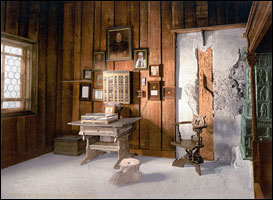
 The Wartburg Castle where Saint Martin translated the Bible into German. |

In May 1521, at the Diet of Worms, Luther made his courageous defense of On The Babylonian Captivity of the Congregation. For that reason, Elector Frederick the Wise feared for the life of the Reformer, and his soldiers "kidnapped" the Saint and hid him away in the Wartburg Castle. While "imprisoned" there, Luther translated the Bible from Hebrew and Greek into German. That is the place where he also threw the inkwell at the Devil.
|
|
|

In 1525, Saint Martin took another step which caused consternation at the Vatican—he married his sweetheart—escaped nun Saint Katharine von Bora.
|
|
|


THE MOST TMELY, TRUTH, AND NUMERICAL SITE IN CONTINUED ON PAGE 2